
 Completing B.Com is a big achievement, but for many students, the real question begins after graduation: -
What should I do next to get a good job?
A B.Com degree gives you knowledge of accounting, business, taxation, economics, and finance. But in today’s competitive job market, a degree alone is often not enough. Companies prefer candidates who have practical skills, software knowledge, communication ability, confidence, and real-world exposure.
This is why choosing the right job-oriented courses after B.Com is very important. The right course can help you become career-ready, improve your resume, prepare you for interviews, and open opportunities in accounting, finance, business operations, analytics, taxation, and corporate roles.
If you are a B.Com student, fresher, or graduate looking for a strong career path, this guide will help you understand the best career-focused courses and skills you should learn after B.Com.
Why Job-Oriented Courses Are Important After B.Com
 Most students complete B.Com with theoretical knowledge, but when they apply for jobs, they face challenges such as:
No practical accounting experience
Limited knowledge of corporate tools
Weak resume presentation
Lack of internship experience
Low confidence in interviews
Confusion about career options
Difficulty understanding real company work
Job-oriented training helps bridge this gap. It teaches you how work is actually done in companies and prepares you for entry-level roles.
A good practical course can help you learn:
Real accounting entries
Invoice processing
Bank reconciliation
GST and taxation basics
Excel and reporting
Business communication
Resume writing
Interview preparation
Corporate work culture
This makes you more confident and employable.
Best Career Options After B.Com
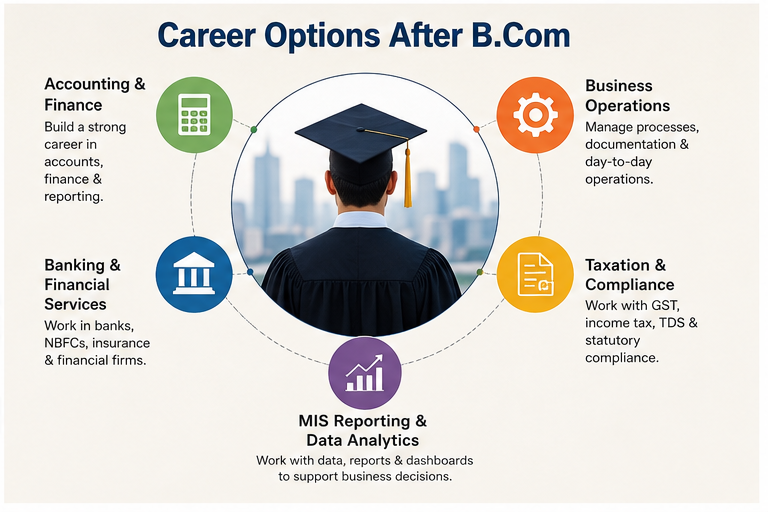 After B.Com, you can build a career in many fields. Some of the best career options include:
1. Accounting and Finance
Accounting and finance are among the most popular career paths for B.Com graduates. Every company needs accounting professionals to manage financial records, payments, reports, and compliance.
You can apply for roles such as:
Accounts Executive
Junior Accountant
Finance Executive
Accounts Payable Executive
Accounts Receivable Executive
Tax Assistant
Audit Assistant
Billing Executive
To enter this field, you should learn practical accounting, Excel, GST basics, Tally or accounting software, reconciliation, and financial reporting.
2. Business Operations
Business operations is another strong career option for B.Com graduates. In this field, you help companies manage day-to-day processes, documentation, coordination, and reporting.
Common job roles include:
Operations Executive
Back Office Executive
Process Associate
Business Support Executive
Documentation Executive
Vendor Coordination Executive
This field is suitable for students who are organized, good at communication, and interested in business processes.
3. Banking and Financial Services
B.Com graduates can also build careers in banks, NBFCs, insurance companies, and financial service firms.
Possible roles include:
Banking Operations Executive
Customer Relationship Executive
Loan Processing Executive
Credit Support Executive
Insurance Operations Executive
Financial Services Associate
For this career path, you should understand finance basics, documentation, customer handling, banking processes, and Excel.
4. Taxation and Compliance
If you are interested in GST, income tax, TDS, returns, and compliance, taxation can be a good career path.
You can work as:
Tax Assistant
GST Executive
Compliance Executive
Accounts and Tax Executive
Junior Tax Consultant
This field requires attention to detail, updated knowledge, and practical training.
5. MIS Reporting and Data Analytics
Many companies need professionals who can prepare reports, dashboards, and business insights. This is where MIS and analytics skills become useful.
Useful tools include:
Microsoft Excel
Advanced Excel
Power BI
Google Sheets
Basic data analysis tools
Possible job roles include:
MIS Executive
Reporting Executive
Data Support Executive
Business Analyst Trainee
Operations Analyst
This is a good option for students who enjoy working with numbers, reports, and business data.
Top Job-Oriented Courses After B.Com
Now let’s look at the best courses that can help you become job-ready after B.Com.
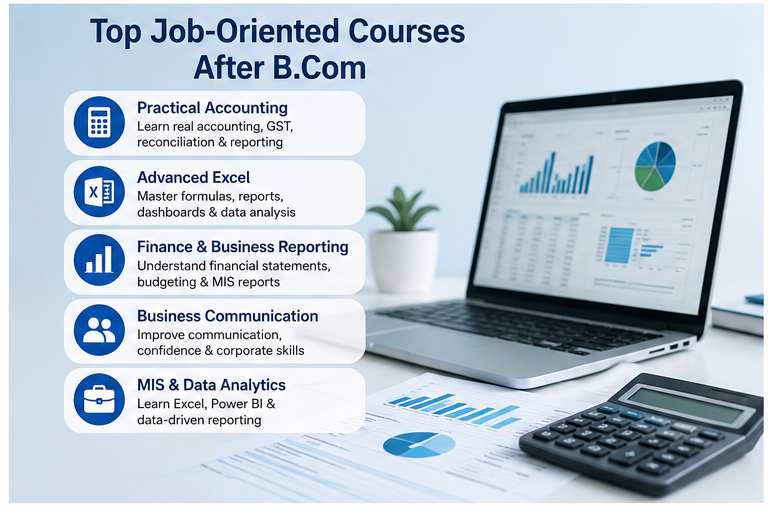
1. Practical Accounting Course
A practical accounting course is one of the best options after B.Com. It helps you understand real accounting work instead of only theory.
You can learn:
Journal entries
Ledger posting
Trial balance
Profit and loss account
Balance sheet basics
Bank reconciliation
Invoice processing
Accounts payable and receivable
GST basics
Monthly reporting
This course is useful for students who want to work as accountants, finance executives, or accounts assistants.
2. Advanced Excel Course
Excel is one of the most important tools for commerce graduates. Almost every accounting, finance, operations, and reporting job requires Excel knowledge.
You should learn:
Formulas and functions
Pivot tables
VLOOKUP/XLOOKUP
Data cleaning
Charts
Conditional formatting
MIS reports
Dashboard basics
Advanced Excel can increase your chances of getting selected in interviews because it is used in almost every company.
3. Finance and Business Reporting Course
This course helps students understand financial data and business reports.
You can learn:
Financial statement basics
Budgeting concepts
Profit analysis
Cost analysis
Business reports
Monthly MIS
Financial decision-making
This course is useful for students who want to enter finance, reporting, business analysis, or corporate finance roles.
4. GST and Taxation Course
Taxation is a valuable skill for B.Com graduates. Many companies and CA firms need candidates who understand GST, TDS, income tax basics, and compliance work.
You can learn:
GST registration basics
GST invoice format
Input tax credit
GST return basics
TDS basics
Income tax basics
Compliance documentation
This course is useful for students who want to work in tax firms, CA offices, finance departments, or compliance teams.
5. Business Operations Course
A business operations course helps you understand how companies manage their internal processes.
You can learn:
Process management
Documentation
Vendor coordination
Client communication
Invoice and payment follow-up
Reporting
Workflow management
This course is useful for students who want corporate jobs but do not want to work only in accounting.
6. Power BI and MIS Course
Power BI and MIS reporting are useful for students who want to enter data-driven roles.
You can learn:
Data visualization
Dashboard creation
Report automation
Business insights
Excel to Power BI reporting
Data presentation
This course can help you apply for MIS, reporting, analytics, and business support roles.
7. Internship-Based Career Training
Internship-based training is one of the most useful options for freshers. It gives you practical exposure and helps you understand real work.
Through internships, you can:
Work on real projects
Understand company processes
Build professional confidence
Improve your resume
Learn from mentors
Get experience certificates
Prepare for full-time jobs
For fresh graduates, internship experience can make a big difference during interviews.
Skills Every B.Com Graduate Should Learn
Along with courses, you should also focus on building important career skills.
Technical Skills
Accounting basics
Excel
GST basics
Tally or accounting software
Power BI basics
MIS reporting
Financial statements
Business documentation
Soft Skills
Communication
Email writing
Interview skills
Time management
Problem-solving
Teamwork
Professional behavior
Confidence
Employers prefer candidates who have both technical and soft skills.
How Placement Support Helps Freshers
Many students complete courses but still struggle to get jobs because they do not know how to apply properly or prepare for interviews.
Placement support can help you with:
Resume building
Mock interviews
Job search strategy
LinkedIn profile improvement
Interview questions
Career counseling
Company referrals
Application guidance
This support helps you become more confident and prepared for job opportunities.
Why Choose Prowise Learning Hub?
Prowise Learning Hub focuses on helping learners build practical, career-ready skills. It is designed for students, fresh graduates, working professionals, managers, and business leaders who want to grow in their careers.
At Prowise Learning Hub, learners can explore professional training in areas such as:
Accounting
Finance
Business operations
Technology
Leadership
Career acceleration
Professional certifications
Internship-based learning
Placement preparation
The learning approach focuses on practical training, expert mentorship, real-world projects, internships, resume support, interview preparation, and career guidance.
The goal is not only to complete a course, but to help students become confident, skilled, and job-ready.
Who Should Join These Courses?
These courses are suitable for:
B.Com students
Fresh B.Com graduates
Commerce students looking for jobs
Students interested in accounting and finance
Candidates looking for internships
Freshers who need placement support
Working professionals who want to upgrade skills
Students confused about career options after B.Com
If you want a better career after B.Com, practical training can help you take the right step.
Final Thoughts
B.Com is a strong degree, but your career growth depends on the skills you build after graduation. In 2026, companies want candidates who are practical, confident, skilled, and ready to work.
By choosing the right job-oriented courses after B.Com, you can improve your career opportunities in accounting, finance, taxation, business operations, banking, MIS reporting, and analytics.
The best way to start is by learning practical skills, gaining internship experience, preparing your resume, and getting proper career guidance.
If you are ready to build your career, explore practical courses, internships, mentorship, and placement support at Prowise Learning Hub.
Call to Action
Ready to become job-ready after B.Com?
Explore career-focused courses at Prowise Learning Hub and take your first step toward a successful career in accounting, finance, and business.
FAQs
1. Which is the best course after B.Com for getting a job?
The best course depends on your career goal. Practical accounting, advanced Excel, GST and taxation, finance reporting, business operations, and Power BI are good job-oriented courses after B.Com.
2. Can I get a job after B.Com without experience?
Yes, but it can be difficult. Practical training, internships, resume preparation, and interview practice can improve your chances of getting selected.
3. Is accounting a good career after B.Com?
Yes, accounting is one of the most stable career options after B.Com. You can work as an accountant, accounts executive, finance executive, tax assistant, or audit assistant.
4. Why are internships important after B.Com?
Internships give you real work experience, improve your resume, build confidence, and help you understand corporate work culture.
5. Which skills are important for B.Com graduates?
Important skills include accounting, Excel, GST basics, financial reporting, communication, email writing, interview skills, and professional behavior.
6. Can B.Com graduates work in finance?
Yes, B.Com graduates can work in finance roles such as finance executive, accounts executive, banking operations executive, MIS executive, and financial reporting assistant.
7. Does Prowise Learning Hub provide career support?
Prowise Learning Hub focuses on practical training, internships, mentorship, resume building, interview preparation, and placement support to help learners become career-ready.
8. What is the best way to start a career after B.Com?
The best way is to choose a career path, learn practical skills, complete an internship, prepare your resume, practice interviews, and apply for relevant entry-level jobs.